At night I lie in the mountains. It's quieter when birds sing
Strangers aren't likely to approach this lonely wilderness
My car is cold. I'm lonely. My thoughts twist around
One day away from home is like ten months
Naturally, I wanted to reply in kind. My goal was to show I had grokked Chris's poem by restating its sentiments in different words.
In addition, I challenged myself to work within the constraints of a line-internal rhyme scheme: the 2nd, 4th, and 7th (final) syllables of each line all share an ending sound.
A certain Mr. Stasse (featured several times on this website) has temporarily withdrawn from society to live at a Buddhist retreat.
Original Title: 《老傻赐新隐士》
2020-10-13: On reflection, I dislike the third line and will probably change it. It's a leftover from the first draft, and out of place.
秋风摇树果不应
愿隐士身旁同赏
人生弯曲预无因
他稳似果拟之值
Rough translation (updated 2020-10-13):
Autumn wind shakes the trees, but the fruits don't go along
I wish the hermit was here to appreciate it, too
Life's twists and turns aren't worth guessing at
He is steady, like the fruits, and that's worth imitating
In September, Chris Stasse sent me a letter which concluded with his calligraphic rendering of "Countryside Pleasures No. 6" 《田园乐——六》, by Tang-era master poet Wang Wei. My reply to Chris included a parody of the same poem.
My version's title swaps out the third character, 乐 le4 "pleasure, happiness", for the rhyming word 恶 e4 "evil, vicious, harmful." Here is "Countryside Nastiness," by Wang Wei's little-renowned cousin, Wrong Wei.
桃红中坏烈焰
柳绿烧成灰柱
花落腾于热气
鸟啼出窝恐离
Translation:
Red peaches suffer from fierce flames
Green willows burn up into pillars of ash
Flowers fall, then rise on heated gusts
Birds cry, leaving their nests in fear
This page describes Linguary, an application to support two major activities in language analysis: (1) storing source material which has caught the user's interest, and (2) grouping and commenting on source material to attack or defend a hypothesis. This page, like Linguary, is a work in progress.
Linguary was born to serve my own needs in translation, linguistics, and recreational language learning, but I intend to make it useful for others (though there are no plans to make it applicable to non-Chinese languages.) The application was first mentioned on this site under the earlier name "Linguist's Working Environment," in my June letter to h0p3.
This is a translation of an image, seen on Twitter, about the current state of the Three Gorges Dam. I've done my best to preserve the news voice, and to ensure the accuracy of all technical terms related to flood control.
Translation
On July 18th, Xinhua News reported that, as a result of heavy rainfall, on the 17th the "second 2020 Yangtze flood" began in the upper reaches of the Yangtze.
Paper Republic (PR) is a charitable organization which promotes Chinese literature in translation. PR's founder, a well-known translator named Eric Abrahamsen, doubles as the organization's sole technical staff member. He recently recruited me to assist with creating new platform functionality permitting PR website users to add to a database of Chinese literature. I'll provisionally refer to this new feature as "Book Lookup."
As currently designed, Book Lookup will ask the user to type in an ISBN. After being validated, the ISBN will be submitted to internal or external lookup services, through which Book Lookup can automatically populate the PR database with verified information.
After a few months of intermittent work, my translation of Lao She's short story "Iron Bull and Sick Duck" is ready to share. So far as I know, nobody has ever before translated this story into English.
This is my translation of a social media narrative posted by someone living through the COVID-2019 outbreak in China. The original author is "Qian Wan" (a pseudonym.)
I originally translated this thinking it could become part of a group project, but logistical difficulties prevented them from using it, so I'm publishing it here. Anything I'm unsure of is marked like this.
Translation
This is an account of daily life in a rural county seat in Jiangxi Province, China, under the shadow of the COVID-2019 outbreak. No cases have been confirmed, but the popular sentiment is one of anxiety. It is in such moments that we most want to maintain empathy, for in the face of this crisis all people are feeling a shock to their spirits. No single element can exist separately from the whole.
I recently joined the unCoVer initiative [homepage / Facebook / Instagram], a group of volunteers translating Chinese accounts of ordinary people's experiences while living in areas affected by the nCoV-19 epidemic. I've done line editing, copy editing, and proofreading of translations, and may later be doing translations myself. If you're interested in a new perspective on this global event which is affecting so many lives, I urge you to read and subscribe to unCoVer's social media pages.
Two windows next to each other, one of which shows usage instances for the word under, or around, the cursor.
Part of the challenge of creating an interface to help with Chinese translation lies in defining the extent of a word. For example, when a verb and an object (e.g. 吃东西 ), is combined with a two-character complement (e.g. 起来), the result, 吃起东西来, does not contain "起来" as a substring, because two-character complements get split up to follow both verb and object. Any digital dictionary or reference system concerned with usage examples will have to account for this fact of Chinese grammar, and contain the knowledge that, despite the results of affixation, this can be considered an occurrence of the "起来" complement.
This is my translation of 《铁牛和病鸭》, by Lao She. The (rough) first draft was finished on 2020-02-15. The second draft was finished on 2020-03-04. Many thanks to Chris Stasse for helping me take this from rough draft to final version.
I chose to translate this story for the challenge of rendering the sections which deal with Sick Duck's mental landscape. As far as I am aware, I am the first person to have translated this story into English. It is not listed in the table of contents for Blades of Grass, nor in the contents of Crescent Moon and Other Stories; nor does the Modern Chinese Literature and Culture resource center list this story in its bibliography of English translations of Lao She.
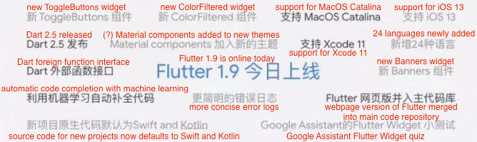
While browsing the Web, I came across this blog post, which announced a new version of Google's cross-platform Flutter framework.
My attention was seized by the image at the top, because there were Chinese words on the presenter's slide! As a little exercise, I annotated the image with English translations of the Chinese terms.
[2020-05-03: The picture below may be broken. It's a known issue as I work to improve the site for better display on small screens.]
Chinese-language version of conference slide announcing Flutter 1.9, with my translations superimposed.
As I watched a friend play the ninja videogame Sekiro: Shadows Die Twice, I noticed an inscription on an enemy samurai's war banner. I wrote it down; now I'm translating it.
有死之荣,无生之辱
Source and Translation
A rough translation of just this phrase is:
Having the honor of death, not the shame of life
This quotation comes from the Wuzi, a Chinese military classic by Wu Qi, a Legalist philosopher who lived during the Warring States period. He was a military leader in Wei and, later, a politician in Chu.
This is my translation of 《马裤先生》, by Lao She. The first draft was published on 2019-10-02. The second draft was published on 2019-10-04 (with thanks to Chris Stasse for some minor improvements.) Portions are marked if I'm still wrestling with them. I worked from the story as published in 《老舍小说集》 ("Collected Fiction of Lao She," ed. Fang Wei, China Society Press, 2004).
Translation
At Beijing Station, the train still had not set off. The man sharing my compartment, in the upper bunk, wore plain glass spectacles, a Western-style green satin shirt, and breeches. In his shirt pocket was a small writing brush; on his feet were dark woolen boots. The man asked, in a friendly manner, "Did you also board at Beijing?"